SkyRoads (Godot SkyRoads)
Port nativo de SkyRoads (Godot SkyRoads) para PC.
SkyRoads (Godot SkyRoads)
Port nativo basado en su ficha de origen.
README del repositorio
Godot SkyRoads
A port of SkyRoads (Bluemoon Interactive, 1993) to Godot 4 — rebuilt from
the original's own data and checked, frame by frame and tick by tick, against
a reference implementation of the DOS engine and against the retail
SKYROADS.EXE itself.
The aim was not "a game that plays like SkyRoads". It was a port whose simulation agrees with the original on every field of every tick, and whose screen agrees with it pixel for pixel wherever that is achievable.
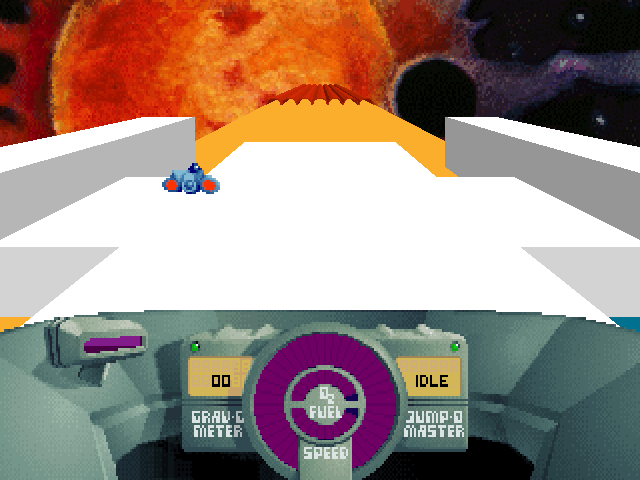
How close is it?
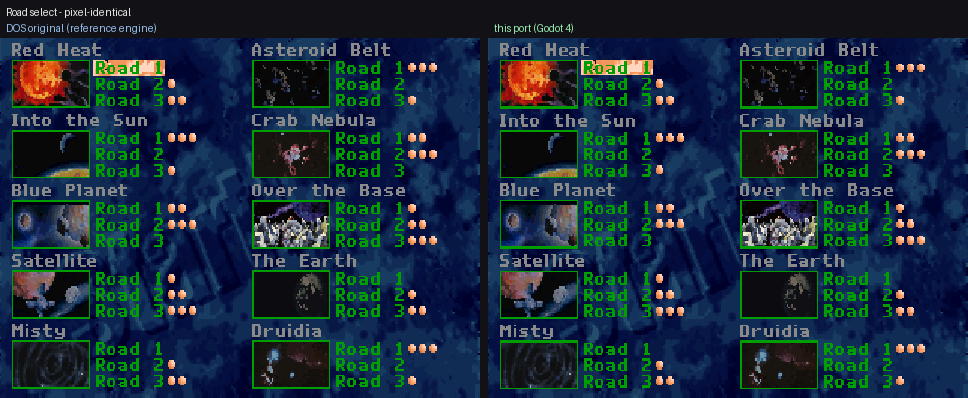
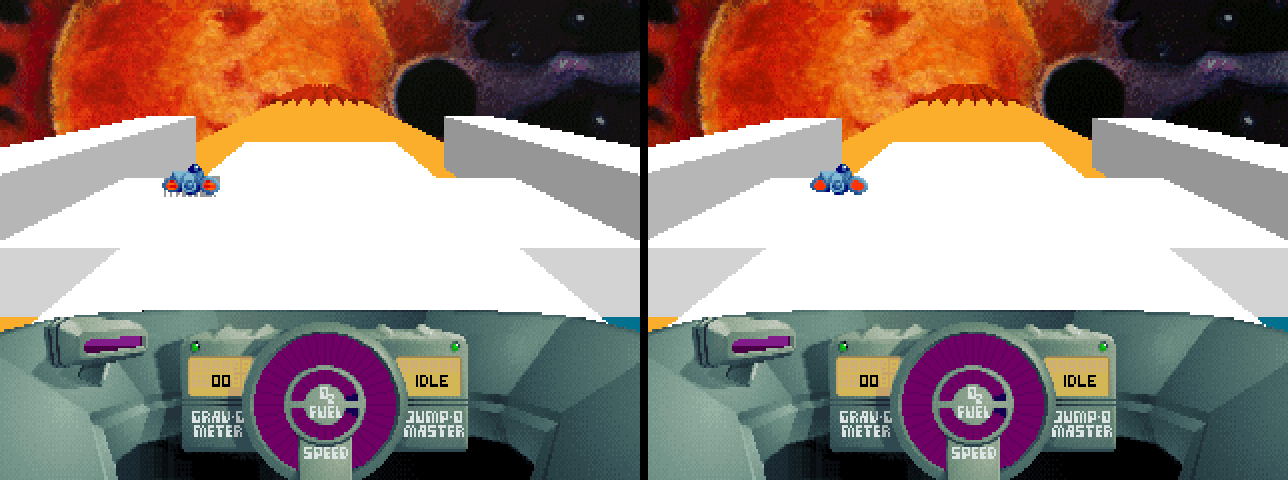
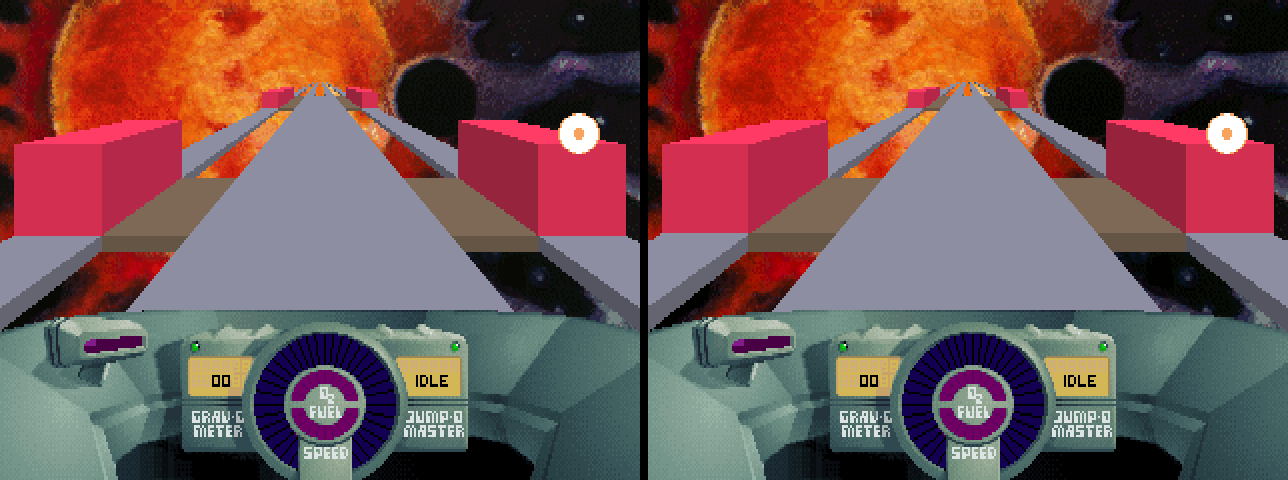
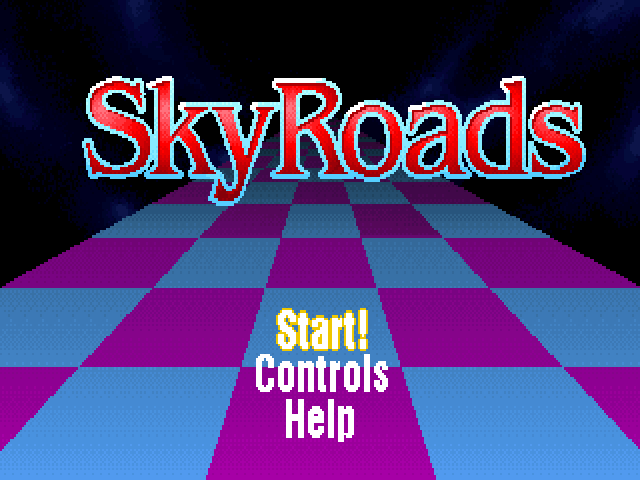
Close enough that most comparisons are a diff of zero. The left half of each image below is the DOS engine; the right half is this port, driven by the same recorded input to the same tick.
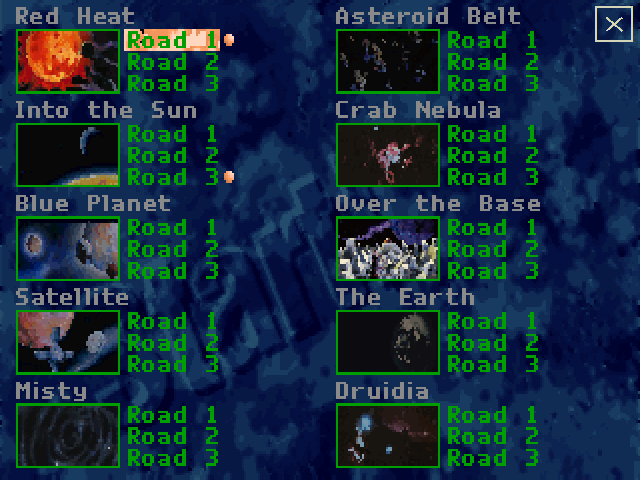
Road select — pixel-identical, 0 differing pixels of 64,000:
Driving into a tunnel — the arch profile is decoded from the original's span tables, not modelled by eye:
A dark world — the backdrop, its stars, and the road's shading:
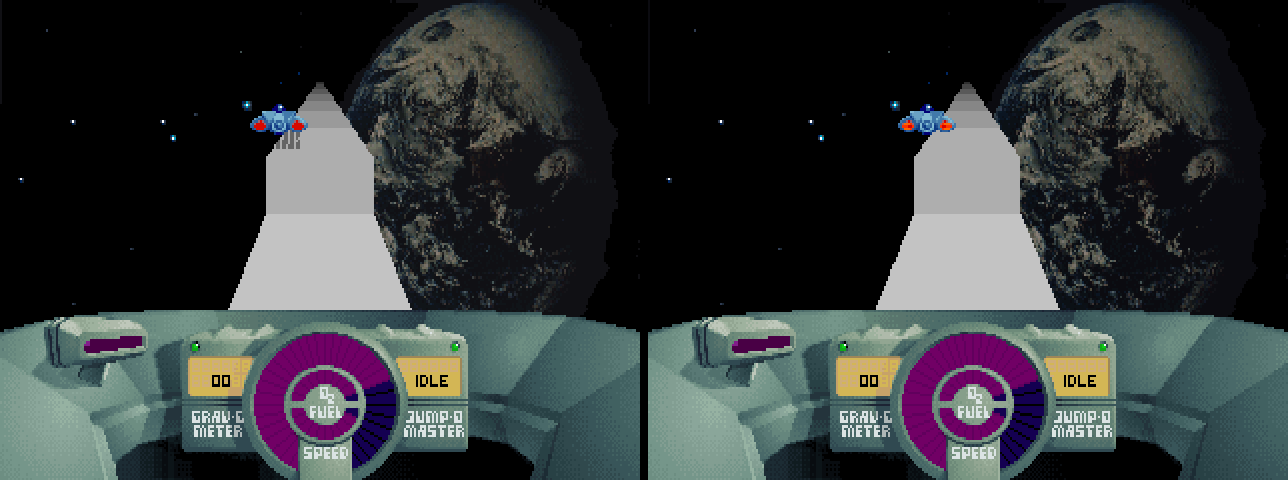
A crash — the explosion art is byte-identical to the original's sprite cells, and the animation runs on the same counter:
Measured parity, as of the last verification run:
| what | result |
|---|---|
| Simulation vs C and Python reference engines | 60,964 ticks, 24 fields, three engines, identical |
| Dashboard band vs the DOS frame | 0 differing pixels across a whole run |
| Menu screens (road select, settings, help) vs DOS | 0 differing pixels |
| Backdrop vs its source art | 0 differing pixels |
| Roads completed end to end, in the real scene | 23 of 30 — the other 7 have no solved route yet |
| Road geometry, RGB, rows 34..128 | 0.5% - 2.0% of road pixels on roads 2, 5, 21 and 26 |
| Road geometry, from inside a tunnel | 6.4% — the worst frame in the game, and what is left of it is named |
Measure road parity in RGB, not palette indices. Classifying to the
nearest palette entry counts differences nobody can see: road 26's greys sit
4/255 apart, and index comparison reported 33% where RGB reports 10%. See
docs/BUGS.md §12.8. Every figure above is RGB.
The road-geometry difference used to be five to twelve times larger, and what
closed it was measurement rather than a better camera. The original's vertical
projection is not one pinhole: the camera reproduces the DECK band edges to
0.24 px, and RAISED surfaces are drawn on a different ladder entirely — read
straight off the baked span tables, identical for half-height and full-height
blocks, and exactly 1:1 at the ship's own depth. Applying it as a vertex term
beside the horizontal cone that was already there took road 21 from 7.9% to
1.7% and road 5 from 8.4% to 2.0%. See docs/BUGS.md §12.18
and §12.19; §12.7 covers what is left, and four earlier attempts at moving the
camera are recorded there so they are not retried.
Measured against the 1993 binary, not against a C port
The port was originally written against skyroads-port/, a C reimplementation.
That turned out to prove very little: fourteen defects have now been found by
disassembling the retail SKYROADS.EXE, and every one of them was present in
the C reference too, which is why no test could see them. The shell
(BUGS.md §11, eleven of them), the frame composer (§12.1), and the gameplay
song's no-repeat rule (§12.10).
So "matches the C reference" is not evidence here. The method that replaced it:
# code image starts at (u16 at EXE offset 8) * 16; addresses in the RE notes
# are code-segment relative; the data segment is paragraph 0x66E
from capstone import Cs, CS_ARCH_X86, CS_MODE_16
plus tools/dump_bands.c kindlines <slot> for the span records a composer
consumes. Collision, the movement integrator, in_tunnel, surface effects,
both tank burn rates, the HUD's three formulas and the autopilot have all been
read this way and match (§12.6, §12.9); the attract demo and the road-end
screen have not.
The C reference is a measuring instrument, and where it was wrong it has been
corrected — those patches live in
docs/reference-corrections/, because
skyroads-port/ and analysis/ are sibling checkouts and not part of this
repository. Apply them before trusting any parity number.
The game
 | 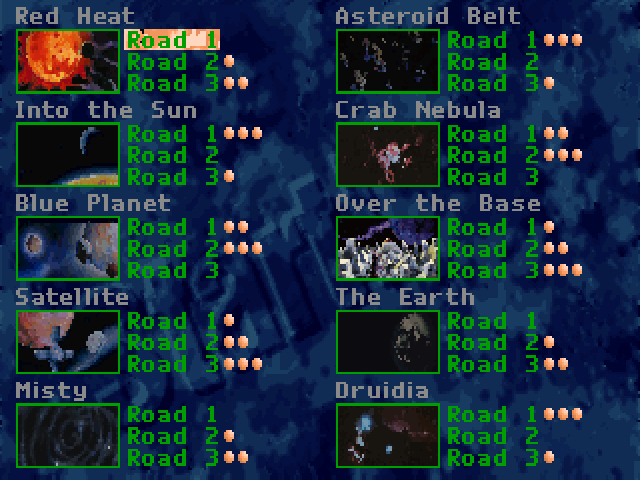 |
| Main menu | Road select — 30 roads across 10 worlds |
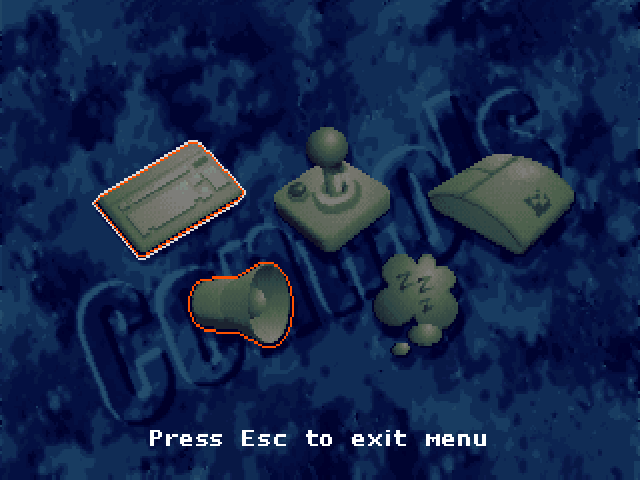 | 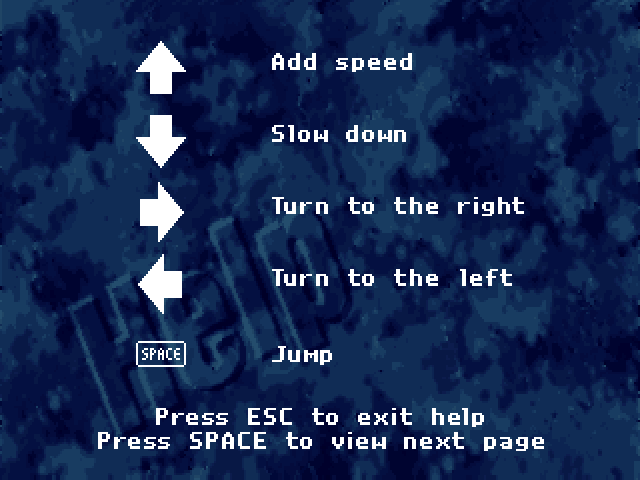 |
| Settings — the active device and sound state outlined in orange | Help |
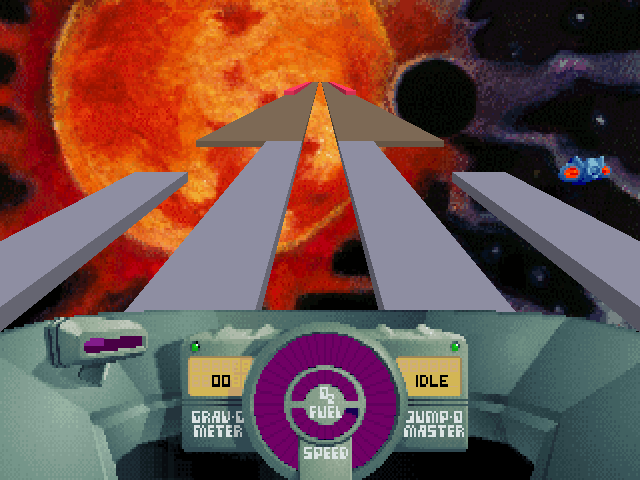 | 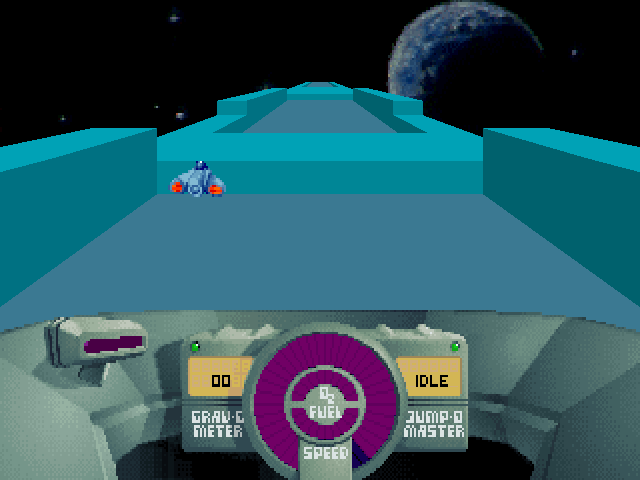 |
| Road 1 | Road 5 |
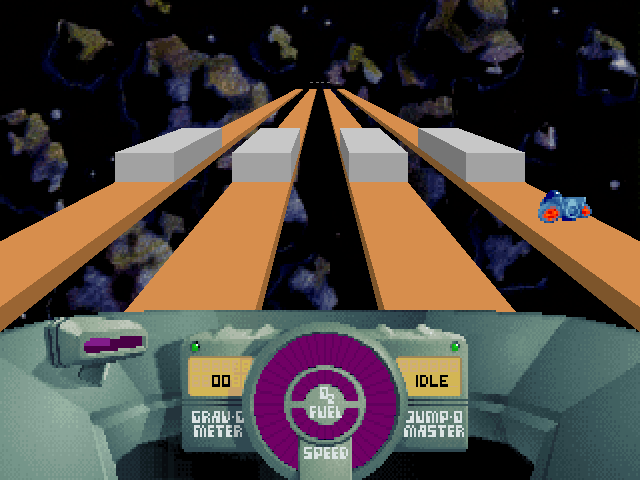 | 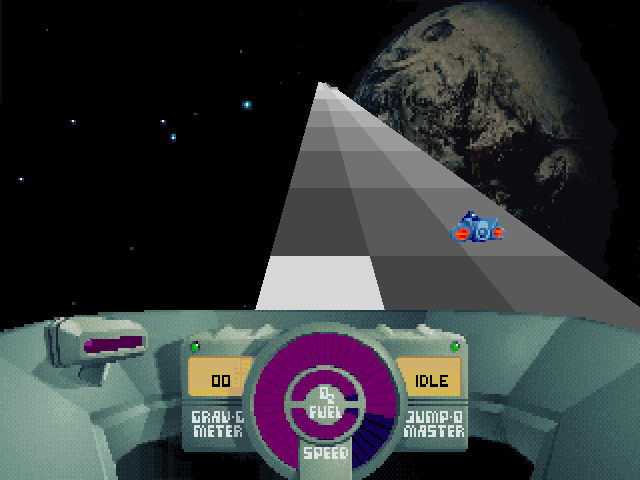 |
| Road 16 | Road 26 |
The boot intro runs the original's whole sequence — title, animation, the logo wiped in over 18 frames, and five credit plates cross-faded through their own palette pairs. Any key skips it; sitting through all thirty-three seconds of it starts the 1993 attract demo instead, which is the only way the original ever reaches it.
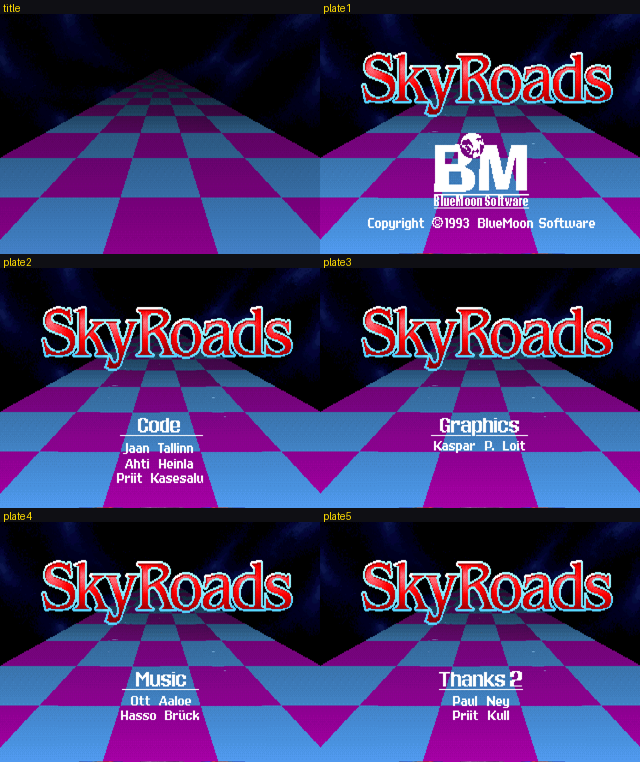
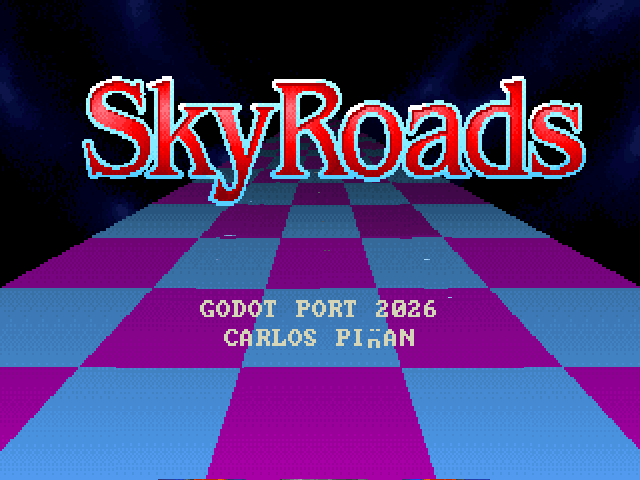
The port adds one plate of its own, after the original's five and on the same timing — drawn in the game's own 8x8 font at the plates' own colour rather than from any retail art, so it reads as part of the sequence without pretending to be one of Bluemoon's:
Running it
You need Godot 4.4 or newer (developed against 4.7) and the retail SkyRoads data — see Game data below.
godot --path .                            # intro, menu, play
godot --path . -- --road 7                # straight into road 7
godot --headless --path . -- --replay 1   # replay road 1's solved route
godot --path . -- --editor mytrack        # the road editor
Controls follow the original, including its four diagonal keys — one key meaning "steer and throttle", because many keyboards cannot report three simultaneous presses:
| Arrows | steer, throttle, brake |
Q E Z X (or Home/PgUp/End/PgDn) | the diagonals |
| Space | jump |
P | pause |
L / C | object IDs / collision overlay |
F2 or R | dump a replayable recording of this run |
Joystick and mouse are selectable on the settings screen, as in the original, which also marks the setting currently in force in orange. A gamepad reads the left stick or the d-pad, and A/B/X/Y, either shoulder and either trigger all jump — the 1993 joystick had two buttons and either of them jumped.
No controller has ever been plugged into this. The gamepad path is written
against Godot's Input API and covered by tests/test_input.gd at the mapping
level, which is the part that can be tested without hardware; the thresholds
were reasoned from a resting stick's noise rather than measured on one.
Making a road
--editor NAME opens a grid editor on user://levels/NAME.json. It is not on
any menu, and deliberately: the seven menu screens are compared against the
reference at 0 differing pixels, and an eighth item would fail that.
| Arrows, PgUp/PgDn, Home/End, mouse | move the cursor; a click also paints |
1-7 | hole, floor, tunnel, half block, half+bore, full block, full+bore |
Q W E R T Y | plain, sticky, ice, supplies, boost, burning |
A M | fill the row, or every row between the mark and the cursor / set the mark |
I D | insert / delete a row |
[ ] | shorter / longer (shift for ten rows) |
U | undo — shift+U redoes; sixty steps, and the header is in them too |
G F O B | gravity, fuel rows, oxygen seconds, backdrop world |
V | read the next problem |
S L | save / reload |
P | play-test it |
C | ask the solver whether it can be finished at all |
H | the key list, on a page of its own |
It draws the same glyphs sra ascii_map prints, so a grid here and a dump
there read against each other.
It validates as you type, because the format lets you build roads nobody can
finish. Structural faults — no tunnel in the last row to finish in, a hole
under the spawn, a gap with gravity at 20 where the ship cannot jump — are
errors, and P refuses to play. Fuel and oxygen budgets are warnings and
never errors: the arithmetic says roads 14 and 28 are longer than their tank
with no supply tile, and road 14 is replayed to completion by the gate on
every run, so the shipped game beats the estimate.
C shells out to the analysis toolkit next door, which is a separate checkout
and not part of this repository — so it says what is missing rather than doing
nothing. It is authoritative in one direction only: a route found is a proof,
because it is replayed from scratch; finding none is not proof that none
exists. On a failure it puts the cursor on the row the search died at,
which is the answer to "why not" far more often than the verdict is.
Roads written by the editor go in user://, never next to data/levels/:
those are derived from Bluemoon's ROADS.LZS and LICENSE carves them out,
while a road you build is your own work. Any of them can be driven directly
with --road 0 --level-file user://levels/NAME.json.
examples/vaults.json is one built this way, with a solved route beside it.
Its first draft was unsolvable and the solver said where: row 34.7, three rows
of ice ending against a wall with one open lane. See examples/README.md.
The editor is desktop only. It is keyboard and mouse, it has no touch layer, and a 320x240 grid driven by a thumb would be a different program. It is excluded from the phone build's reach by the same thing that keeps it off the menus: there is no way in but a command-line flag.
On a phone
Run on a Pixel 10 Pro XL, 2026-09-01 — the first time this build had been on real hardware rather than an emulator. The whole screen, letterbox and all:
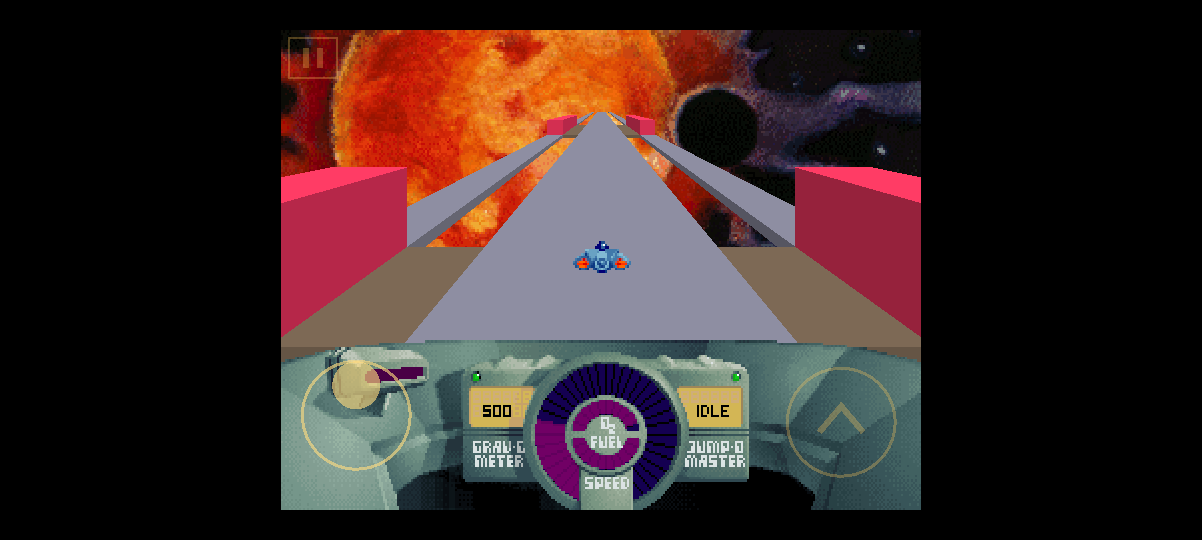
The bars are geometry, not an oversight. A 320x240 picture is 4:3 and the phone
is 2.23:1, so no scale factor fills one with the other; scale_mode="integer"
then costs 52% of the screen against 40% for a fractional scale that would
resample the pixels. Keeping the exact field of view was a deliberate choice —
docs/BUGS.md §12.25 has the numbers and the three options.
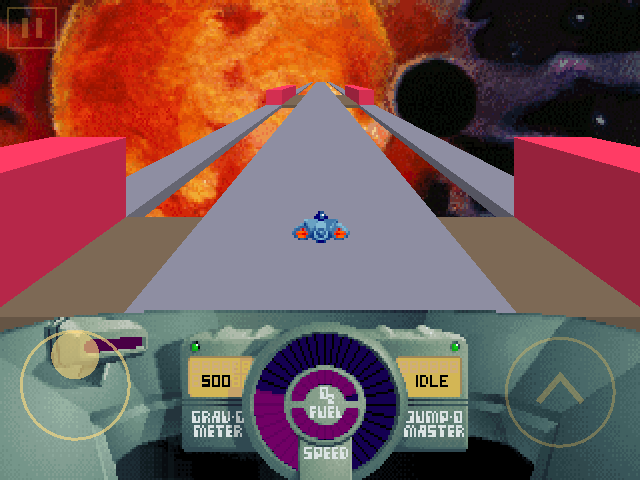 | 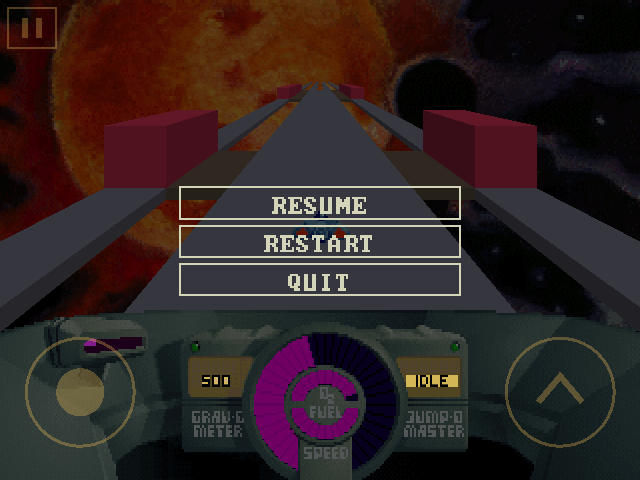 |
| The stick deflected up, mid-run | RESUME / RESTART / QUIT over a dimmed frame |
 | 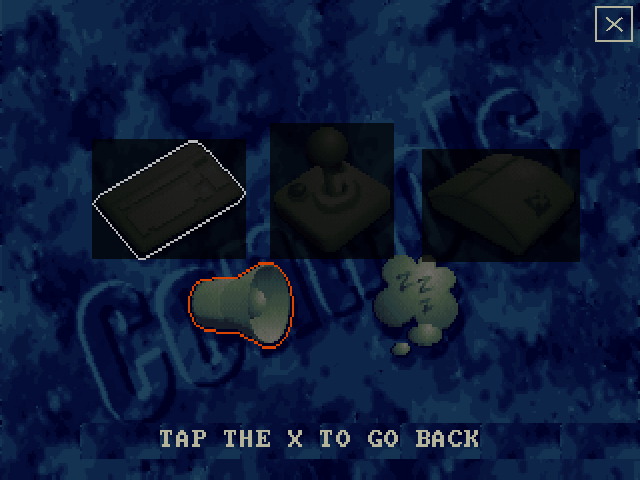 |
| Two taps: one selects, one starts | Keyboard rows dimmed, X to leave |
Android and iOS presets are in export_presets.cfg; both need the matching
export templates installed, and Android additionally needs the build template
(Project → Install Android Build Template) because Play wants an AAB.
A touch build differs from a desktop one in six places, all of them shell,
none of them simulation. SkyRoads.is_mobile() gates them, and it is Android
and iOS specifically — not OS.has_feature("mobile"), which is also true of a
web export on a touch device:
- A thumbstick and a jump button (
scripts/TouchControls.gd). The drawn circles are a hint; the hit areas are the whole left and right halves of the screen, and the stick's origin follows the thumb that starts it. Both feedPlayerInput.from_axes— the same function the joystick and mouse devices use — so the simulation is handed the same three values it always was. - A pause box, top LEFT, the farthest point on the screen from the jump
button so it cannot fire mid-jump. It opens RESUME / RESTART / QUIT over
a dimmed frame — the original's
Pand its "ESC while paused", plus the restart a phone has no other way to ask for. - An X in the top right of the main menu, the road select and the settings
screen. A phone has no Esc, and those are the screens Esc would leave. It
raises
Key.ESCAPErather than adding a second way to navigate, so the main menu quits the app and the other two go back — exactly what the model already does with that key. A tap that hits no item does nothing. It used to mean "go back", which reads fine with a mouse and is unusable with a thumb: a road cell is 48x9 canvas pixels, so most of the road select is not a cell, and reaching for a road mostly left the screen instead. Found on a Pixel 10 Pro, which is also why the road hit areas are now the full row pitch rather than the drawn cell. - No keyboard wording. The retail menus say "Press Esc to exit menu" and "Press SPACE to view next page", painted into the 320x200 pictures. On mobile those lines are covered with background taken from the SAME ROW's left margin — the wording is centred, so the margin is always background and the row keeps its own lighting — and the port writes "TAP THE X TO GO BACK" and "TAP TO TURN THE PAGE" in the game's own 8x8 font. One derived texture in memory; no art file is modified and nothing is forked.
- Taps navigate the menus. Each hot region is an overlay pict's own
rectangle out of
gfx.json, so the layout is the original's rather than invented. On the road list a tap selects and a second tap on the same road starts it — thirty small cells and an instant launch is a bad pairing. - The settings screen hides the control row. Keyboard/joystick/mouse are
dimmed and unreachable: the device is the touchscreen, and nothing on that
row could change it. The sound setting is untouched.
PlayerInput.TOUCHis chosen by the platform and never written toskyroads.cfg, which stays byte-compatible with a DOS save.
The screen stays letterboxed at 4:3 (stretch/aspect="keep"). "Expand" would
show more of the world than DOS did and quietly invalidate every parity
measurement in docs/BUGS.md on the one platform nobody is measuring.
The letterbox is large, and it cannot be painted. scale_mode is integer,
so the picture takes the largest whole multiple that fits: on a 2992x1344
screen that is 5x — 1600x1200 at offset (696, 72), because 6x would need 1440
rows. That leaves 696px of black either side. Filling it needs aspect=expand
plus the game rendered into a fixed 320x240 SubViewport, which moves both
what Main._capture_* photographs and the transform touch_shell.gd maps taps
through. See the end of docs/BUGS.md §12 — it is a mobile-phase job, not a
tweak.
That 5x offset is also the number to compute tap coordinates from when driving
a device over adb. Getting it wrong looks exactly like a broken button.
To see the touch layout without a phone:
godot --path . -- --touch --road 2 # mouse drives the on-screen stick
Game data
This repository contains no retail game files. data/ holds derived
exports — PNG, JSON, Ogg — produced from a copy of the 1993 release by the
analysis toolkit that lives alongside this project.
SkyRoads was released as freeware by Bluemoon Interactive and is still distributed by them. The derived assets here are included so the port is runnable and reviewable; they remain the work of Bluemoon Interactive, and nothing in this repository is offered under a licence that could grant rights to them. The code is the part this project claims.
See LICENSE: the port's code is MIT, and the file lists exactly
which paths under data/ are Bluemoon's derived work and therefore outside
that grant.
How it was built
The port is checked against a reference implementation of the DOS engine rather than against screenshots or memory — and, where that reference turned out to be wrong, against the retail binary. Four things follow from that.
The simulation is bit-exact. A three-way differential runs the same input through the C reference, a Python model and this GDScript implementation and compares 24 state fields on every tick — position, velocity, fuel, oxygen, collision flags, the lot. 60,964 ticks over the shipped levels and 150 randomised trials, with no disagreement — and the Python side is now anchored to the retail binary rather than to the C reference, so the agreement means something it did not before.
The renderer is derived from the original's tables, not fitted by eye. The
DOS game has no 3D: every scanline of every tile shape is a span list baked
into TREKDAT.LZS. Those tables were decoded to recover the projection —
which turned out to be a vertical pinhole plus a separate horizontal cone
that no single camera reproduces — and the tunnel arch, the block faces and
the band ordering all come from the same source.
The reference is checked too. docs/BUGS.md §11 is a pass measured
against the retail SKYROADS.EXE itself rather than against the C
reimplementation — disassembled with capstone, with the retail .LZS files
decoded alongside. It found eleven defects the C reference shares, so no
existing test could see them: a main menu with no SkyRoads logo, a settings
screen that never showed which setting was active, an intro that stopped
twenty-three seconds early, the wrong menu music, a third help page the
original never displays, a post-game screen that waited for a key it should
not, fades the player could not skip, a road-select cursor that refused two
moves the original makes, a confirm key the original does not accept, and an
attract demo triggered from the wrong place entirely — the retail menus block
on int 21h ah=7 and cannot time out, so the demo comes off the end of an
unskipped intro and loops back into it. All eleven are fixed, and three of
them had been written down as "authentic" on the C reference's word.
Findings are recorded, including the wrong ones. docs/BUGS.md
is the audit trail. Several defects turned out to be misdiagnosed: a reported
"near-row darkening" did not exist (the reference paints one colour at every
distance — the real fault was two swapped block faces), and "chunky blue stars"
were not stars at all but the sky's black rendering as a texture-importer
artefact. Fixes that were tried and measured worse are written down too, so
nobody repeats them.
Tests
QUICK=1 ./verify.sh            # 605 checks in ~80 s — the edit loop
./verify.sh                    # + 23 roads driven end to end, ~20 min — the gate
THREEWAY=1 ./verify.sh         # + C vs Python vs GDScript on real levels
QUICK=1 runs every assertion the full gate does. The 23 end-to-end
replays it skips drive real scenes at the real tick rate, so they cost real
time: one measured run printed parse 8s rendering 62s suites 8s end-to-end 687s, which is 90% of it. They contribute no assertions of their
own; what they prove is that the whole stack, from Main.tscn through
GameLoop's accumulator into the simulation, still finishes a road. So QUICK
is for the edit loop and the full run is for a commit, and a QUICK run
deliberately does not print the words VERIFY OK — a grep for those must never
match a run that never drove a road. The phase line prints either way, so the
split stays a measurement.
verify.sh runs three passes, because a suite run alone lies in two
documented ways: a syntax error in an unreferenced file ships green, and a
suite that dies before asserting prints no failures. Every suite must print a
positive Result: line.
| suite | covers |
|---|---|
test_physics | the simulation against golden traces |
test_menu | shell navigation, diffed step-by-step against the C engine |
test_hud | every dashboard readout, at its boundaries |
test_audio | music and sfx assets, loop points, song sequence |
test_input | keyboard, joystick, mouse and touch mapping |
test_occlusion | what hides the ship — including inside a tunnel |
render_menu, render_dashboard, render_backdrop | pixels, against frames the reference engine drew |
test_geometry, test_data, test_timing, test_launch_options | mesh, level data, fixed-step loop, CLI |
test_touch | the on-screen stick: screen halves, floating origin, two thumbs at once |
touch_shell | a synthetic tap through the real input pipeline into the real scene |
test_intro | the intro's phases, durations and palette pairs, stepped tick by tick |
test_editor | the road format, the validation rules against all 31 shipped roads, undo, fill, row surgery |
test_editor_shell | the editor reached the way a person reaches it: keys through the tree, a mouse click, the play-test round trip |
The pixel suites compare against golden frames produced by the reference
engine, not against this port's own past output — so drift is measured
against the original, not against yesterday. Where the reference itself was
found to be missing something, the golden is repaired with the retail art
rather than with the port's output: the settings screens have the original's
orange state overlays composited in from SETMENU.LZS before the diff, so
the comparison is still against 1993 and not against ourselves.
New suites in this project are mutation-tested: the code is deliberately broken, the tests are confirmed to fail, and the break is reverted.
Layout
scripts/          the shell, the renderer, the simulation
  model/          pure logic, no scene tree: MenuModel, HudModel, PlayerInput,
                  RoadEditModel (the road format and what makes one unplayable)
  app/            LaunchOptions (the command line), CaptureService (--shots and
                  friends), InputDevices (keyboard, pad, mouse, stick)
data/             derived assets + the recovered camera and tables
  branding/       app icons, generated from the game's own art
tests/            suites, fixtures, and golden frames from the reference
examples/         roads built with the editor, and a solved route for one
docs/parity/      before/after evidence for each fidelity fix
scripts/SkyRoadsPlay.gd is the simulation and is proven bit-exact — it is
not edited without a failing three-way trace to justify it.
The analysis toolkit that produced everything under data/ — the exporters,
the route solver, the disassembly and the C reference the port is measured
against — lives outside this repository, alongside it. docs/BUGS.md cites it
throughout; the paths it names are relative to that wider tree, not to this
one.
Credits
SkyRoads is by Bluemoon Interactive (Jaan Tallinn, Marko Kaasik, Ivar Annamaa), 1993. This is an unofficial port. All game design, artwork and music are theirs.
Godot port, 2026 — Carlos Piñan. The game credits it after the original's five plates, on the same timing, rather than over the main menu.
There is no store release: this repository is the deliverable. The package name
com.cpinan.skyroads and the absent keystore and iOS team id are all fine as
they are, and nothing here should be spent on store assets or signing.
What is next
docs/PLAN.md — four things the original never did. The level editor is
built (see Making a road) and the gamepad and stick pass
is in, though nobody has yet played either on real hardware. Left: deciding
what "full screen" should mean on a phone (the letterbox is geometry, not an
oversight — see docs/BUGS.md §12.25) and a first-person mode. The plan says
for each one what it costs and which measured result it puts at risk.
docs/PERF.md — where the frame time and the reading time go, measured.
References
Everything this port was measured against, so that any claim in
docs/BUGS.md can be re-checked from scratch.
The game. SkyRoads, Bluemoon Interactive, 1993. Released as freeware by its authors and still distributed by them at bluemoon.ee — over HTTP; the HTTPS host does not serve it. No retail file is included in this repository.
The measuring instrument. SKYROADS.EXE from that release,
sha256 c3a55223e359749555535e138ef4219bc94458639e44f70edf3cfcb2f28c26ac.
Where this project says "read off the binary" it means that file, disassembled
with Capstone in 16-bit mode: the code
image starts at hdrpar * 16 (the u16 at EXE offset 8), addresses are
code-segment relative, and the data segment is paragraph 0x66E. Every EXE
address cited in the docs is reproducible from those four facts.
The C reference. skyroads-port/, a reimplementation of the DOS engine by
Ammaar Reshi (MIT), which sits outside this repository and was used as a
differential oracle rather than as source. It is wrong in fifteen places that
are now known; each is written up in
docs/reference-corrections/ with the EXE
address that settles it. It bundles Nuked-OPL3 by Alexey Khokholov
(LGPL-2.1) for the FM synthesis.
The engine. Godot 4.7.1 (MIT), using the
gl_compatibility renderer on every platform — including mobile, which Godot
would otherwise put on a different pipeline than the one every measurement in
docs/ was taken on.
The analysis toolkit. analysis/, also outside this repository: the Python
model of the simulation, the level and asset decoders, the route solver, and
the three-way differential harness. tools/ holds the C-side instruments —
replay_frames.c for reference frames and surface maps, dump_bands.c for the
baked span tables, and the Python comparators frame_compare.py,
sid_compare.py and make_compare.py.
Comentarios (0)
Inicia sesión para dejar un comentario.
Sé el primero en comentar sobre este juego.